
ONEST Explained: Ukraine, Four Years Later
Four years after Russia’s full-scale invasion, the war has reshaped Europe, global alliances, and the international order.

Memory, Endurance, and the War That Reshaped Europe
On February 24, 2022, Russian forces launched what the Kremlin believed would be a three-day operation to take Kyiv.
Four years later, Ukraine stands.
The war did not end in seventy-two hours.
It did not end in 2022.
It did not end in 2023.
It did not end in 2024.
It did not end in 2025.
And now, on the fourth anniversary of the full-scale invasion, the world faces a different question:
Not whether Ukraine would survive —
but what survival now means.
The Early Days: A State That Refused to Collapse
In Kyiv this week, President Volodymyr Zelenskyy stood in the bunker on Bankova Street — the same small office where, four years ago, he was urged to evacuate.
His response in 2022 — “I need ammunition, not a ride” — became shorthand for resistance.
But what followed was not rhetoric. It was structure.
Cities mobilized.
Civilian volunteers blocked armored columns.
Recruitment centers filled.
Western military aid slowly materialized.
Sanctions frameworks were built from scratch.
The first phase of the war was about preventing state collapse.
Ukraine did not fall.
Kyiv held.
Kharkiv held.
The government remained intact.
The flag did not come down.
That mattered.
Four Years Later: What Has Changed
The Ukraine of 2026 is not the Ukraine of 2022.
It produces more than three million FPV drones per year.
It fields F-16s.
It operates long-range capabilities.
It integrates Western air defense systems at scale.
It is no longer simply defending. It is adapting.
At the same time, the war has institutionalized itself.
Defense budgets across Europe have structurally increased.
NATO industrial production has expanded.
Multi-year contracts are in place.
Supply chains are now designed around sustained conflict.
The war is no longer an emergency.
It is a system.
The Coalition: Nordic-Baltic Leadership
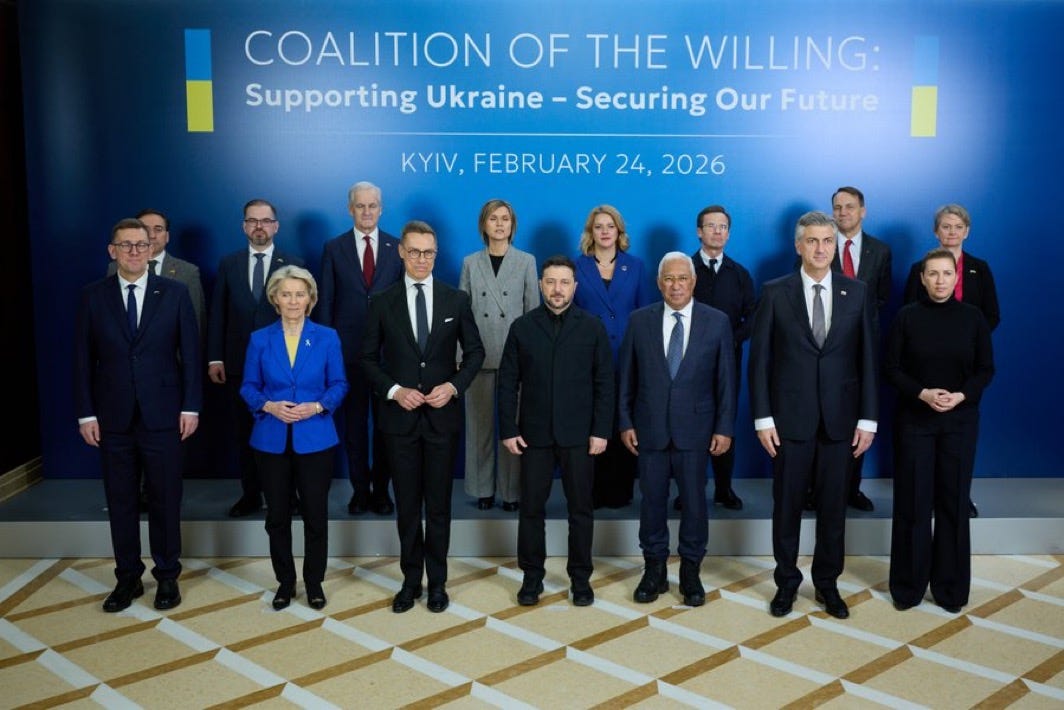
This week in Kyiv, President Zelenskyy gathered with the leaders of the Nordic-Baltic states (NB8): Estonia, Denmark, Finland, Iceland, Latvia, Lithuania, Norway, and Sweden.
Collectively, the NB8 countries have provided more than €42 billion in military, financial, and humanitarian support since 2022.
They pledged:
€1.4 billion through the PURL mechanism in 2025
Nearly €12.5 billion planned for 2026
Continued multi-year military funding
Energy infrastructure protection
Long-term reconstruction commitments
Support for a compensation mechanism and special tribunal
Continued backing for Ukraine’s EU and NATO integration
Their message was not symbolic.
It was structural:
Ukraine’s security is intrinsically linked to Euro-Atlantic security.
This is no longer framed as charity.
It is framed as shared defense architecture.
The Coalition of the Willing: Presence and Absence
On the anniversary itself, leaders gathered in Kyiv.
Some attended in person. Others joined virtually for a meeting of the “Coalition of the Willing,” hosted by French President Emmanuel Macron and UK Prime Minister Keir Starmer.
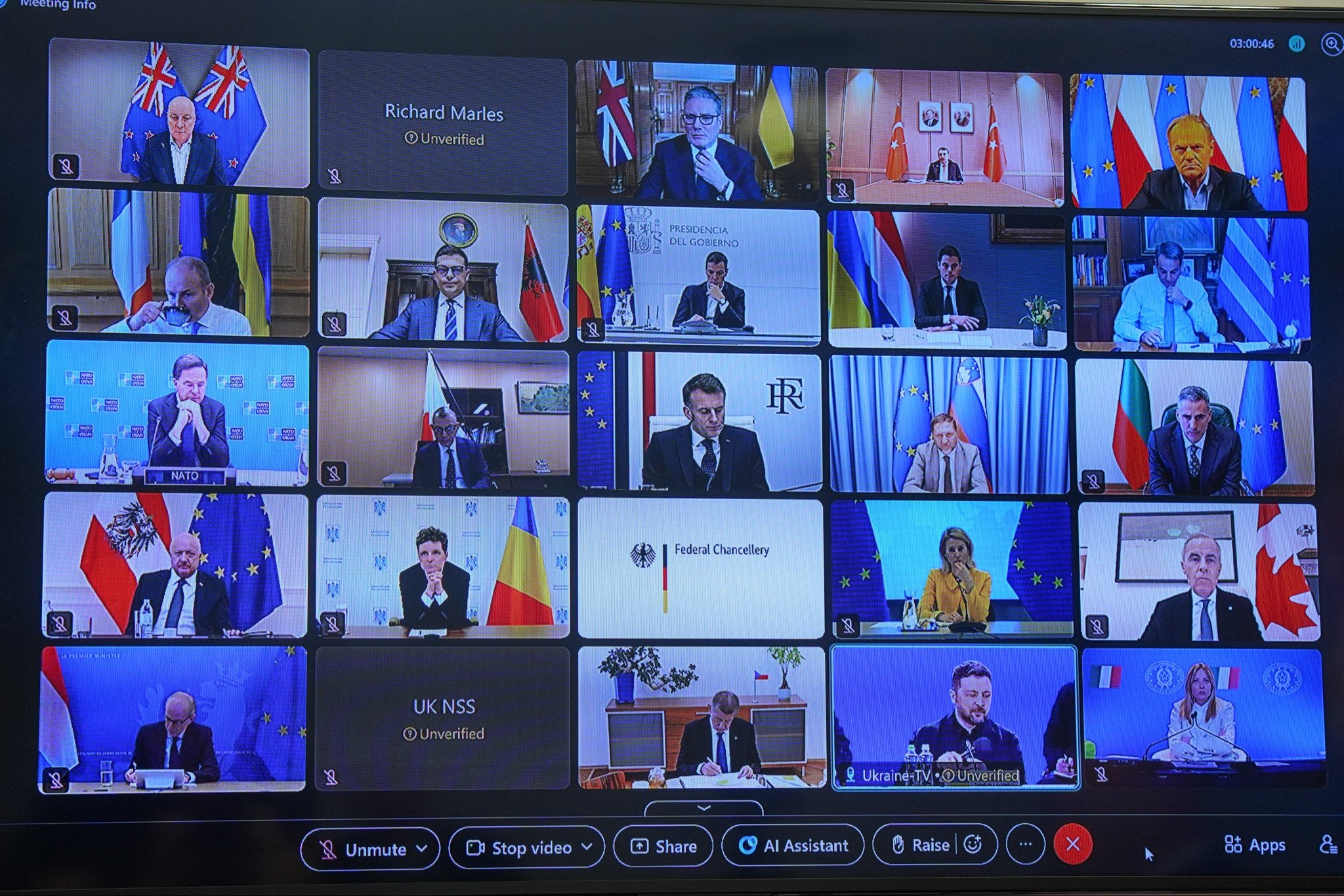
Participants included European allies, Canada, and partners from the Indo-Pacific. The focus was on coordinating long-term security guarantees and ensuring sustained military and financial support for Ukraine.
President Zelenskyy also addressed the European Parliament virtually, receiving a standing ovation — a reminder that within Brussels, the political framing of this war has not shifted.
At NATO headquarters, Secretary General Mark Rutte marked the anniversary:
“NATO stood with Ukraine from the beginning.
We stand with you today.
And we will stand with you throughout the challenges ahead.”
National landmarks across Europe and allied countries were illuminated in blue and yellow.
The visual contrast this week was notable.
Leaders gathered in Kyiv.
Security guarantees were discussed in coordinated forums.
New aid packages were announced.
Yet there was no separate, high-profile White House or State Department anniversary address beyond the joint G7 statement. Public schedules show no senior U.S. administration official present in Kyiv for the commemoration.
In war, presence is policy.
Absence is also read as policy.
Four years in, symbolism carries strategic weight.
The G7: Security Guarantees and Sanctions
On the fourth anniversary of the full-scale invasion, G7 leaders reaffirmed their support for Ukraine’s sovereignty and territorial integrity, backing diplomatic initiatives while emphasizing that any durable peace must be rooted in credible security guarantees.
The language was coordinated: support for Ukraine remains unwavering, and pressure on Russia will continue.
Canada announced approximately $2 billion in new military assistance, including 400 armored vehicles and the renewal and expansion of Operation UNIFIER. It also imposed sanctions on an additional 100 vessels linked to Russia’s shadow fleet and committed further support to the Ukraine Energy Support Fund.
The United Kingdom unveiled its largest sanctions package since 2022, introducing roughly 300 new measures targeting Russia’s oil and military sectors. The package includes sanctions on Transneft, dozens of shadow fleet tankers, and several Russian banks. Britain has now sanctioned more than 3,000 Russian-linked individuals, companies, and vessels.
Across the G7, the pattern is consistent:
Support remains.
Sanctions expand.
Pressure is being institutionalized.
But anniversaries are not only about commitments.
They are about signals.
The United Nations: A Divided Vote
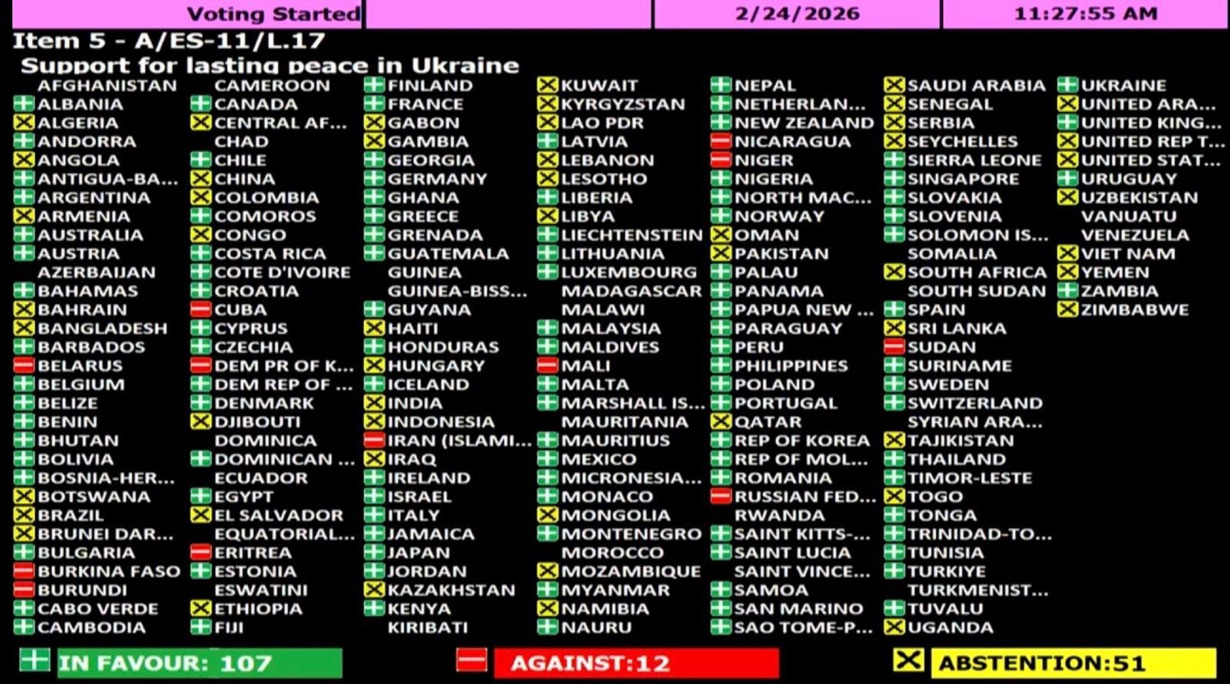
At the UN General Assembly, resolution A/ES-11/L passed:
107 in favor.
12 against.
51 abstentions.
The resolution:
Reaffirmed Ukraine’s sovereignty under the UN Charter
Condemned the invasion
Demanded the return of children and POWs
The United States abstained.
Several Middle Eastern and African nations abstained.
Hungary and Serbia abstained.
Turkey and Egypt voted in favor.
The global map is not binary.
Support for Ukraine remains strong in Europe, but the abstention column reflects geopolitical hedging.
Four years in, the war has reshaped alliances — and exposed the limits of consensus within the international system.
Health, Civilian Life, and the Cost of Time
The World Health Organization has documented at least 2,881 attacks on healthcare facilities since February 2022.
In 2025 alone, attacks increased nearly 20% compared to 2024.
WHO reports:
72% of Ukrainians experienced anxiety or depression in the past year
Only one in five sought help
8 out of 10 cannot access necessary medicines
59% in frontline regions report poor or very poor health
Energy infrastructure continues to be targeted.
Hospitals rely on generators.
Mental health strain is systemic.
War fatigue is not theoretical.
It is medical.
As WHO Director-General Tedros Adhanom Ghebreyesus said:
“The best medicine is peace.”
But peace requires structure, not slogans.
Negotiations, Illusions, and Incentives
Ukrainian officials continue diplomatic engagement, including recent meetings in Ankara and prior negotiations in Geneva.
Russia, meanwhile, advances familiar narratives.
President Vladimir Putin alleged possible nuclear components and sabotage risks targeting pipelines — claims dismissed by UK Prime Minister Keir Starmer as unsupported by evidence.
Ukraine remains a signatory to the Nuclear Non-Proliferation Treaty.
Accusations of escalation often precede justification frameworks.
The pattern is not new.
The deeper issue is structural:
Peace requires concessions from the aggressor.
As EU foreign policy chief Kaja Kallas stated:
“It’s not Ukraine’s army that is obstacle to peace, Russia’s army is.”
Four years in, the war persists not because negotiations are absent — but because incentives remain misaligned.
What Has Not Changed
Putin did not take Kyiv.
Ukraine did not surrender sovereignty.
The Ukrainian state exists.
It exists diplomatically.
It exists militarily.
It exists politically.
It also exists in cemeteries.
In hospitals.
In families fragmented across borders.
Zelenskyy’s anniversary address was not triumphalist.
It was sober.
“Ukraine exists not just on the map. Ukraine is an actor in international relations.”
That is the strategic shift.
Where We Are Now
The war is no longer defined by survival alone.
It is defined by endurance.
Europe has adjusted.
NATO has expanded.
Defense production has scaled.
Energy markets have reoriented.
Sanctions regimes have matured.
Ukraine remains exhausted — but not broken.
Four years after February 24, 2022, the question is no longer whether Ukraine can stand.
It is whether the international system can sustain its own stated principles.
The anniversary is not simply memory.
It is a stress test of global order.
And it is not over.
Stay informed. Stay human. Stay ONEST.
(c) ONEST Network 2026 — Facts First. Clarity Always.