
FEB 13: MSC 2026 — DAY ONE
Factual information is our love language.

SETTING THE STAGE
Before leaders took the stage, the MSC 2026 report: Under Destruction, framed the conference as a reckoning with eroding trust, weaponized dependencies, and institutional strain.
🔗 Full deep dive analysis on ONEST.
GERMANY OPENS MSC
Chancellor Friedrich Merz delivered a direct warning:
“Big power politics has its own rules. It is fast, harsh & unpredictable. It fears own dependencies, but uses and exploits dependencies of others. This is a dangerous game. At first for small players, but later on also for big players.”
On U.S. political culture:
“The battle of cultures of MAGA in the U.S. is not ours. Freedom of speech here ends where the words spoken are directed against human dignity and our Basic Law. We do not believe in tariffs and protectionism, but in free trade.”
On talks with Putin:
“A European PM went to Moscow without a mandate, achieved nothing. The next week Russia struck homes and hospitals.”
“We’re ready to talk. But Russia isn’t serious.”
“This war will end only when Russia is economically, and possibly militarily, exhausted.”
GERMANY–U.S.
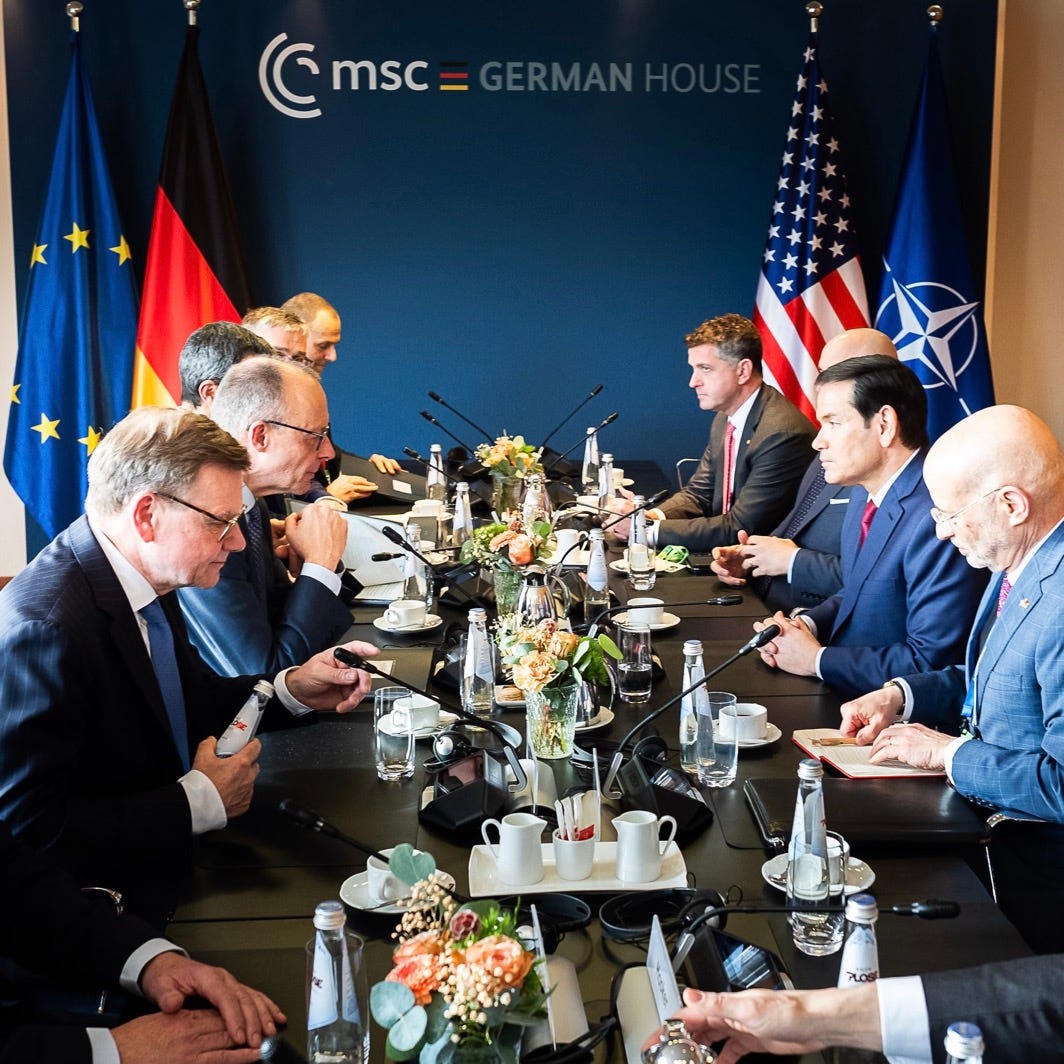
Following his meeting with U.S. Secretary of State Marco Rubio, Merz stated:
“For three generations, trust amongst allies and partners has made NATO the strongest alliance of all times. In the era of great power rivalry, being a part of NATO is not only Europe’s competitive advantage. So let’s repair and revive transatlantic trust together.”
MOLDOVA–U.S.
President Maia Sandu met U.S. Secretary of State Marco Rubio in Munich.
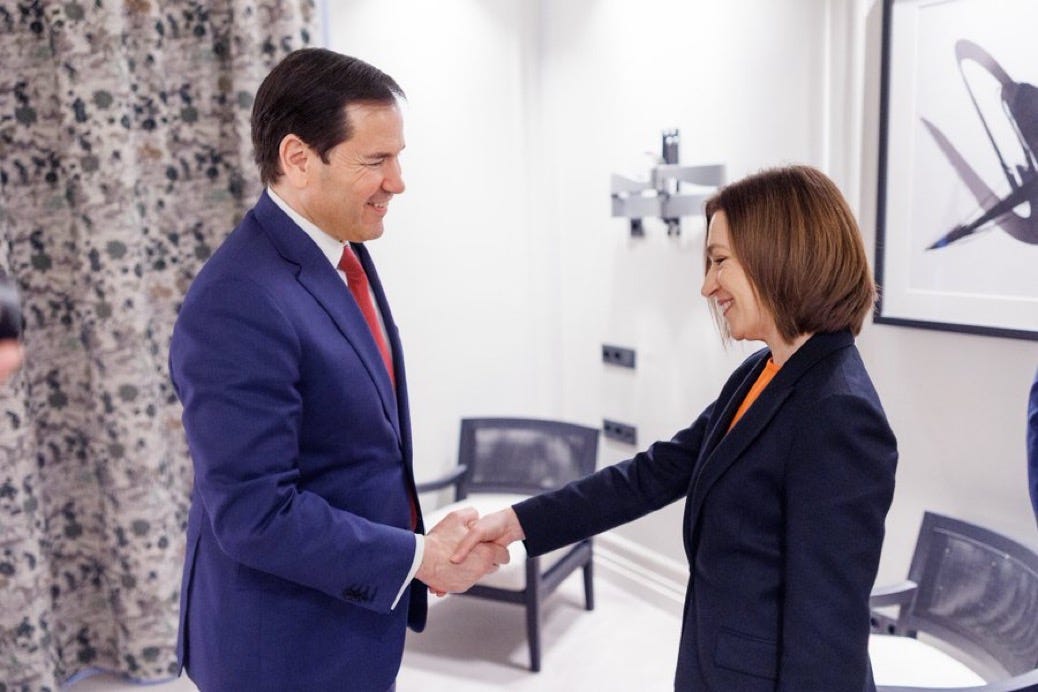
Sandu stated:
“In Munich I met U.S. Secretary of State Rubio. We reaffirmed a results-oriented partnership: the U.S. supports Moldova’s stability and sovereignty, and Moldova remains a reliable partner for regional security, built on long-standing mutual trust.”
For Moldova — a country facing hybrid pressure and energy vulnerability linked to Russia — reaffirmation of U.S. support carries significant weight.
This meeting reinforces that Eastern Europe’s security concerns remain firmly embedded in Washington’s diplomatic agenda.
GERMANY–FRANCE–CHINA
A notable trilateral engagement took place between Germany’s Foreign Minister Johann Wadephul, France’s Jean-Noël Barrot, and China’s Wang Yi.
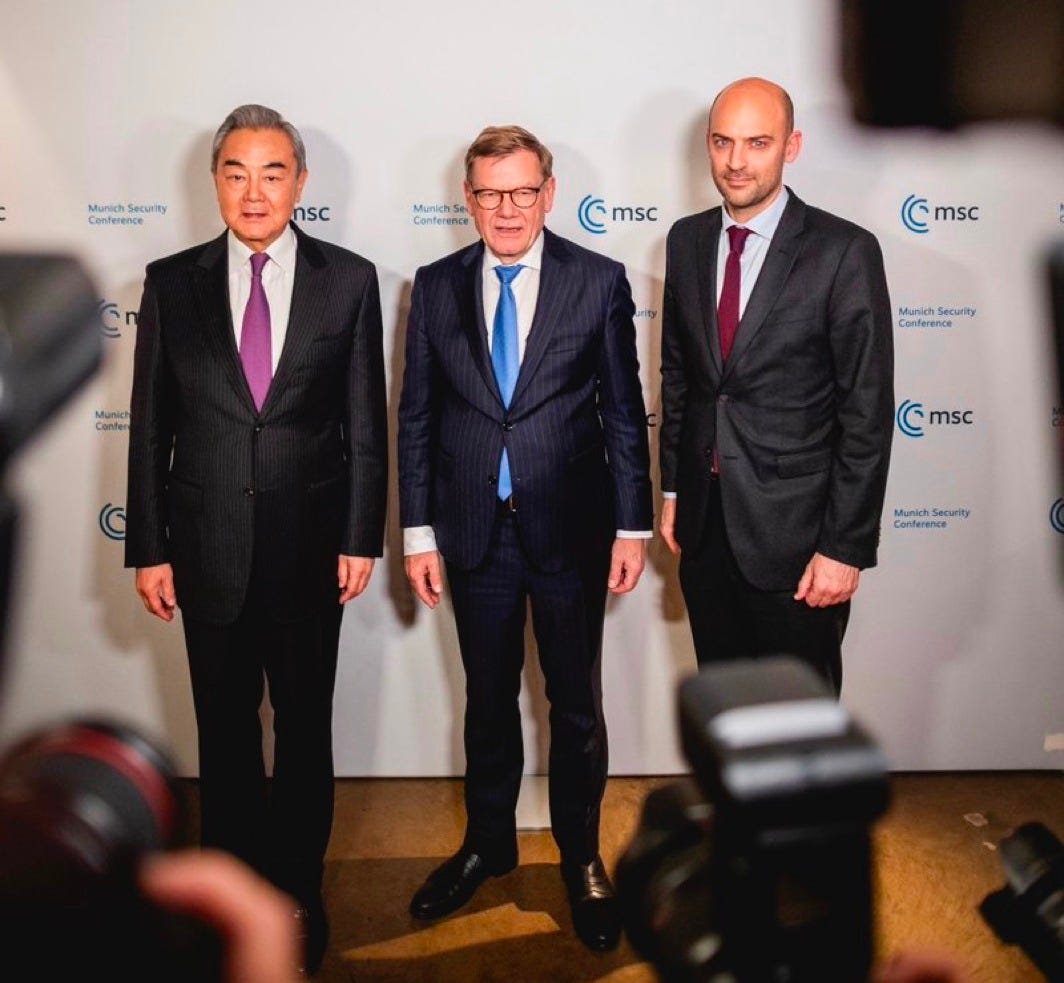
Wadephul stated:
“Face-to-face dialogue with China is key, because there are many issues we need – and want – to discuss, given the politically and economically challenging times. We have strong economic ties. We need open markets and free trade. Competition must be fair and based on rules. Market distortions and export restrictions are not in our interest and harm our economy.”
He added:
“Russia’s war of aggression against Ukraine and its support by third parties jeopardize European security. We expect China to use its influence to ensure a lasting peace for Ukraine.”
This reflects Europe’s dual-track approach:
Maintain economic engagement with China.
Press Beijing on its leverage over Moscow.
China, meanwhile, remains present across multiple conversations in Munich — not absent, not central, but strategically positioned.
FRANCE
President Emmanuel Macron emphasized European agency:
“No peace without the Europeans. You can negotiate without the Europeans, but it will not bring peace at the table.”
“We have to be the one to negotiate new architecture of security for Europe the day after, because our geography will not change.”
“We will live with Russia at the same place. I don’t want this negotiation to be organized by somebody else as Europeans.”
On Russia’s future posture:
“If we reach a settlement on Ukraine, we will still have to contend with an aggressive Russia, with a defensive industry on a sugar high, and a bloated army.”
CANADA–FRANCE
On the sidelines of MSC, Canada’s Minister of Foreign Affairs Anita Anand met with French Foreign Minister Jean-Noël Barrot.
Anand wrote:
“Always a pleasure to exchange with my French counterpart, @jnbarrot. In Munich, we discussed strengthening our collaboration on security in the Arctic and reaffirmed our unwavering support for Ukraine. France is a key partner — and we are aligned for the road ahead.”
The Arctic mention is notable.
As Russia expands military infrastructure in the High North and climate change reshapes strategic routes, Arctic coordination between NATO partners is increasingly central to security planning — not peripheral.
Recent discussions surrounding Greenland’s strategic significance and renewed U.S. emphasis on Arctic missile defense architecture — including proposals related to a North American “Golden Dome”–style defensive shield — have further elevated the region’s geopolitical relevance.
For Canada, Arctic sovereignty and continental defense are not abstract policy debates. They sit at the intersection of NATO coordination, U.S.–Canada defense integration under NORAD, and emerging strategic competition in the polar region.
While Canada’s Foreign Minister Anita Anand participated in Munich discussions, Prime Minister Mark Carney remained in Canada.
Mackenzie Gray reports (video) that Prime Minister Carney and other federal party leaders placed flowers at a memorial in Tumbler Ridge, following the recent tragedy there.
The decision underscores the domestic context shaping Canada’s presence at MSC this year — diplomacy abroad, mourning at home.
(Video via Mackenzie Gray)
UKRAINE
President Zelenskyy:
“We have made many compromises. Putin and his friends are not in prison. This is the biggest compromise that the world has already made.”
“If Russia only agrees to freeze the conflict without clear guarantees, then this is a pause before a new war. We have already been through this after 2014. We do not need another ‘Minsk’ that will give Russia time to prepare.”
“The reality is that today the key to influencing Russia is in Washington.”
“I do not trust Putin. And no one should.”
“My biggest fear is world fatigue.”
BERLIN FORMAT
President Zelenskyy met with Chancellor of Germany Friedrich Merz; President of France Emmanuel Macron; Prime Minister of the United Kingdom Keir Starmer; Prime Minister of Poland Donald Tusk; NATO Secretary General Mark Rutte; President of the European Commission Ursula von der Leyen; President of the European Council António Costa; Italy’s Deputy Prime Minister and Foreign Minister Antonio Tajani; and Canada’s Minister of Foreign Affairs Anita Anand.
Focus:
Security guarantees
PURL initiative
Air defense
Energy infrastructure
Follow-up negotiations by February 24
UKRAINE–CHINA
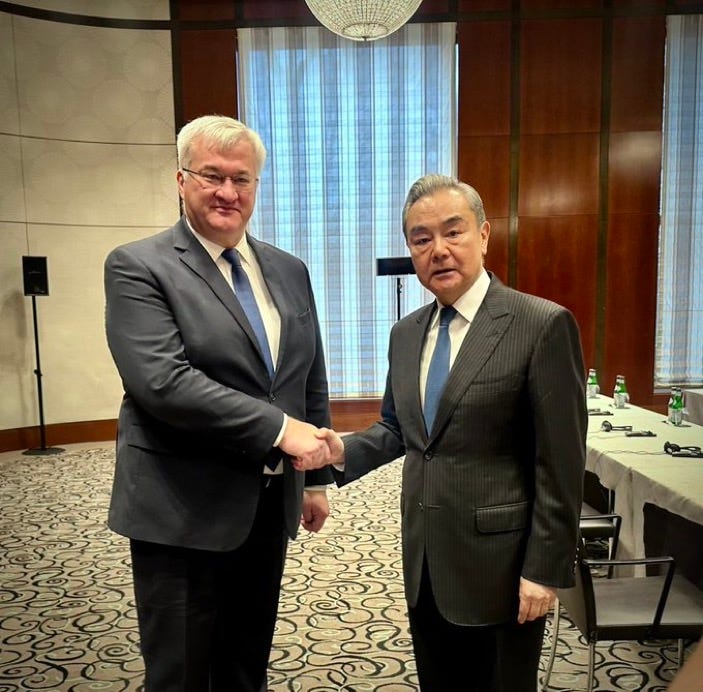
Ukraine’s Foreign Minister Dmytro Sybiha described his meeting with Chinese Foreign Minister Wang Yi as “meaningful and productive.”
According to the Ukrainian readout, discussions focused on:
Developing mutually beneficial trade
Reinforcing bilateral ties based on respect for territorial integrity
China’s potential role in facilitating an end to the war
The battlefield situation and Russian attacks on Ukraine’s energy infrastructure
Damage to Chinese companies operating in Ukraine due to Russian strikes
Beijing confirmed it will provide an additional humanitarian energy assistance package to Ukraine.
Sybiha reiterated Ukraine’s interest in high-level contacts with China and formally invited Wang Yi to visit Kyiv. He also accepted an invitation to visit China.
ONEST Note:
China’s position remains complex — balancing economic interests in Europe, strategic ties with Russia, and its stated support for territorial integrity. Ukraine’s outreach reflects a widening diplomatic hedge amid prolonged conflict.
UKRAINE–NETHERLANDS
President Volodymyr Zelenskyy met with Prime Minister of the Netherlands Dik Schoof, with discussions centered on strengthening air defense and expanding joint weapons production.
Zelenskyy expressed gratitude for the Netherlands’ continued support, including its contributions to the PURL initiative — a mechanism enabling Ukraine to procure air defense systems and missiles.
He emphasized the urgent need for additional air defense interceptors amid intensified Russian strikes and growing ballistic missile production.
Both leaders explored new avenues for reinforcing Ukraine’s air defense architecture and agreed on the importance of closer coordination among partners.
Zelenskyy also noted Ukraine’s interest in establishing a joint drone production facility in the Netherlands, similar to the Ukrainian-German venture recently launched.
Diplomatic efforts toward ending the war were also discussed, including follow-up on recent meetings between Ukrainian, American, and Russian delegations.
UKRAINE–NORWAY
President Zelenskyy also met with Prime Minister of Norway Jonas Gahr Støre.
Zelenskyy thanked Norway for its continued military and energy support, including:
Delivery of NASAMS air defense systems and missiles
Contributions to the PURL initiative
Energy assistance to help stabilize Ukraine’s infrastructure
The leaders discussed Ukraine’s need to strengthen its air defense capabilities, with Zelenskyy stressing that securing Ukraine’s skies remains a decisive factor in forcing Russia toward an end to the war.
Energy resilience was another key focus, with Ukraine preparing to provide partners a detailed list of infrastructure needs.
Both sides also addressed diplomatic steps toward achieving a sustainable peace.
On the sidelines of the Munich Security Conference, President Volodymyr Zelenskyy met Ukrainian skeleton racer Vladyslav Heraskevych and awarded him the Order of Freedom.
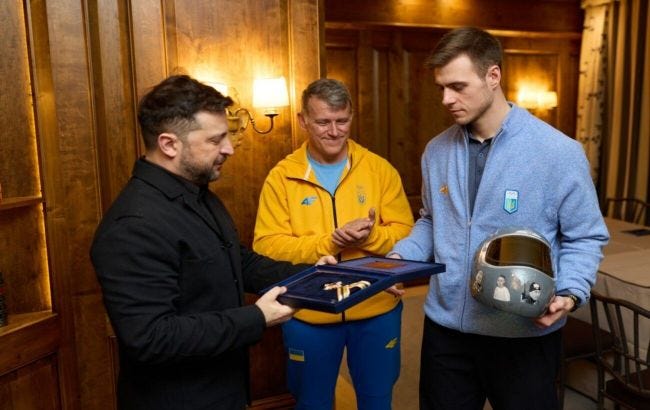
Heraskevych had been disqualified after attempting to compete wearing a helmet honoring 22 Ukrainian athletes killed during Russia’s war.
The Court of Arbitration for Sport (CAS) has now rejected his appeal against the International Olympic Committee. CAS Secretary General Matthieu Reeb stated that while freedom of expression is permitted at the Games, it is not allowed at competition venues.
The episode — now legally concluded — has shifted from Olympic regulation to broader political discourse.
OUTSIDE MSC — GENEVA TALKS
Russia has again appointed Vladimir Medinsky to head its delegation.
Next round of trilateral negotiations (Ukraine–U.S.–Russia) scheduled for February 17–18 in Geneva.
Ukraine delegation includes:
Rustem Umerov
Kyrylo Budanov
Davyd Arakhamia
Serhiy Kyslytsya
Vadym Skibitskyi
HUMANITY & HUMOR — MUNICH MOMENTS
German Chancellor Friedrich Merz greeted UK Prime Minister Keir Starmer and French President Emmanuel Macron beneath a European Union flag in Munich, joking:
“I hope you don’t mind about the European flag.”
(Video by Sophie Wingate)
Hungarian opposition leader Péter Magyar met Polish Prime Minister Donald Tusk on the sidelines of the Munich Security Conference. Introducing his colleague Anita Orbán as the “future minister of foreign affairs of Hungary,” Magyar joked that her surname was “just a coincidence.”
Tusk replied dryly: “My name is Donald.”
(Video by Szabolcs Panyi)
WHAT TO WATCH DAY TWO
U.S. delegation posture and clarity on next steps in the Geneva talks
China’s positioning — both in public messaging and bilateral engagement with European leaders
Institutional security guarantees discussions and any movement on concrete frameworks
Air defense and energy support packages, particularly ahead of the February 24 target date
Canada’s role in the Arctic security conversation and coordination with European partners
Beyond Munich: AFRICAN UNION SUMMIT
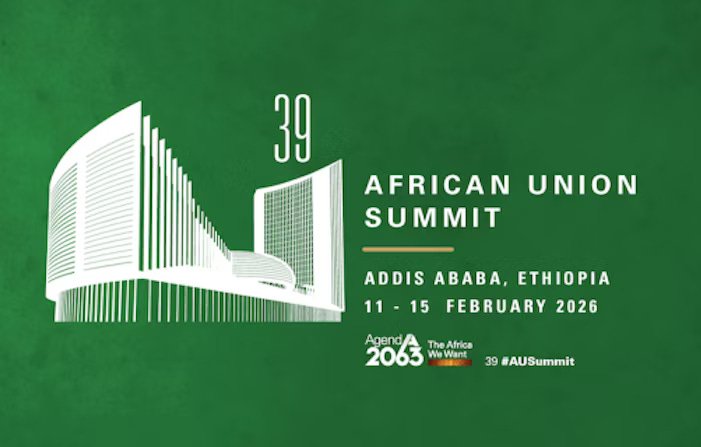
As leaders gather in Munich, heads of state and government are also convening at the African Union Summit — where discussions will focus on regional security, economic integration, governance reforms, and responses to ongoing conflicts across the continent.
At a moment when global supply chains are being re-engineered, critical minerals are reshaping energy transitions, and geopolitical competition is intensifying, Africa’s strategic role is no longer peripheral — it is central.
The conversations unfolding at the AU Summit intersect directly with the debates in Munich: sovereignty, security guarantees, development financing, and the evolving architecture of multilateral cooperation.
ONEST will be following both — because the future of global order is not shaped in one room alone.
Stay informed. Stay human. Stay ONEST.
(c) ONEST Network 2026 — Facts First. Clarity Always.